Modular Data Centers for AI Deployment
- Share
- publisher
- CoolSpace
- Issue Time
- Oct 12,2026
Summary
Modular prefabricated data centers reduce deployment timelines from 18 months to as little as 8 weeks while delivering higher power density per square meter. As AI workload demand outpaces traditional construction, factory-built containerized solutions offer a faster, more cost-effective path to operational capacity.
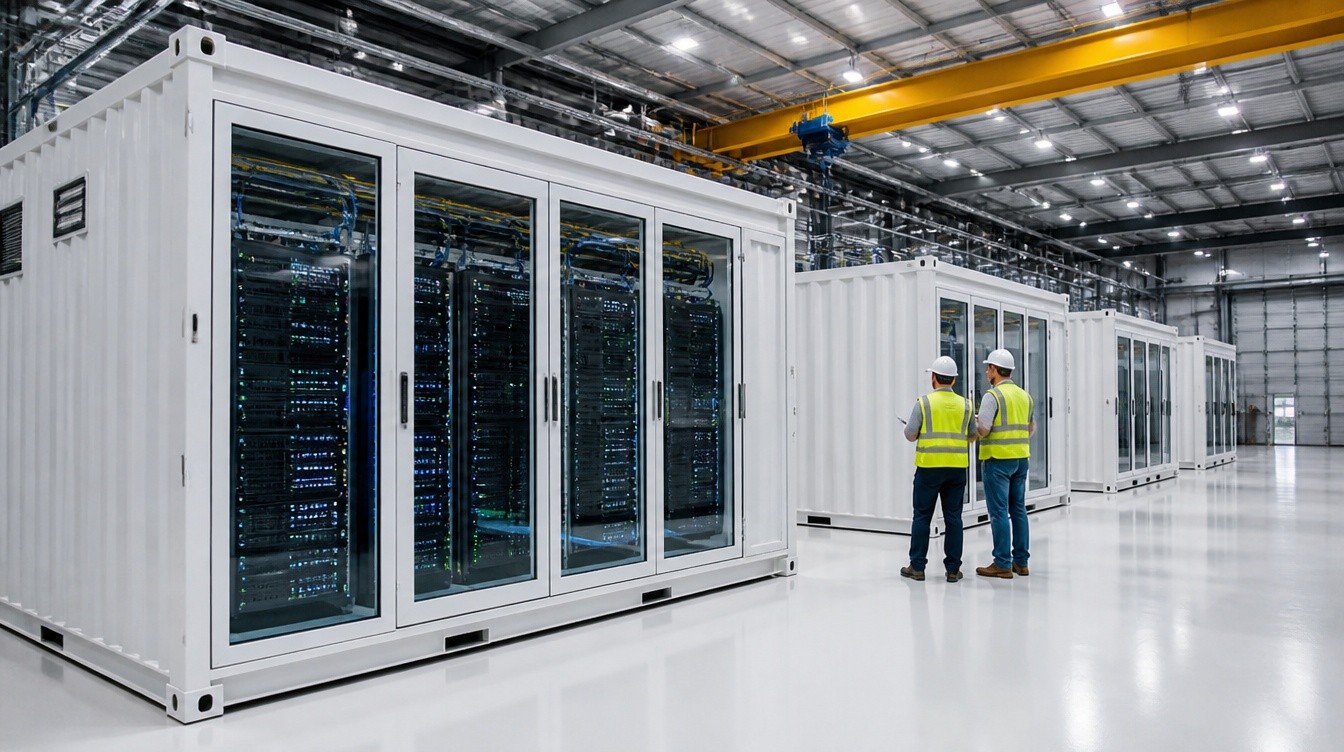
Modular Data Centers: Why Prefabricated Infrastructure Is Winning the AI Deployment Race
Reading time: 7 min read | Published: October 12, 2026 | Category: Data Center Infrastructure
In this article: Key Takeaways · The Speed Gap · Anatomy of a Modular Unit · The Density Advantage · Deployment Models · Financial Comparison · Explore Further
Key Takeaways
- Traditional stick-built data centers take 18–24 months from groundbreaking to first compute load — a timeline increasingly incompatible with the pace of AI infrastructure demand, according to Uptime Institute's 2025 global survey.
- Modular prefabricated units can reach operational status in 8–12 weeks, with factory quality assurance eliminating the variability inherent in on-site construction.
- Power density per unit of floor space is typically 3–5x higher in containerized deployments compared to conventional raised-floor designs, reducing total real estate requirements.
- Standardized modular designs enable incremental scaling — operators can deploy capacity in precise increments matched to demand, avoiding the capital risk of overbuilding.
The Speed Gap: Why Traditional Construction Cannot Keep Pace
The global demand for AI compute infrastructure is growing at a rate that traditional data center construction methods cannot match. Training runs for frontier AI models now require tens of thousands of GPUs operating in parallel, and the organizations funding these clusters need operational capacity in months, not years.
A conventional data center build follows a sequential process: site acquisition and permitting (3–6 months), civil and structural work (4–8 months), mechanical and electrical installation (4–6 months), commissioning and testing (2–3 months). Even with aggressive scheduling, 18 months from decision to first workload is typical. For a multi-building campus, the timeline stretches to 2–3 years.
Modular construction inverts this sequence. While site preparation proceeds on location, the data center modules themselves — complete with server racks, cooling systems, power distribution, and fire suppression — are manufactured, assembled, and tested in a controlled factory environment. When site work is complete, the modules arrive ready to connect to power and network.
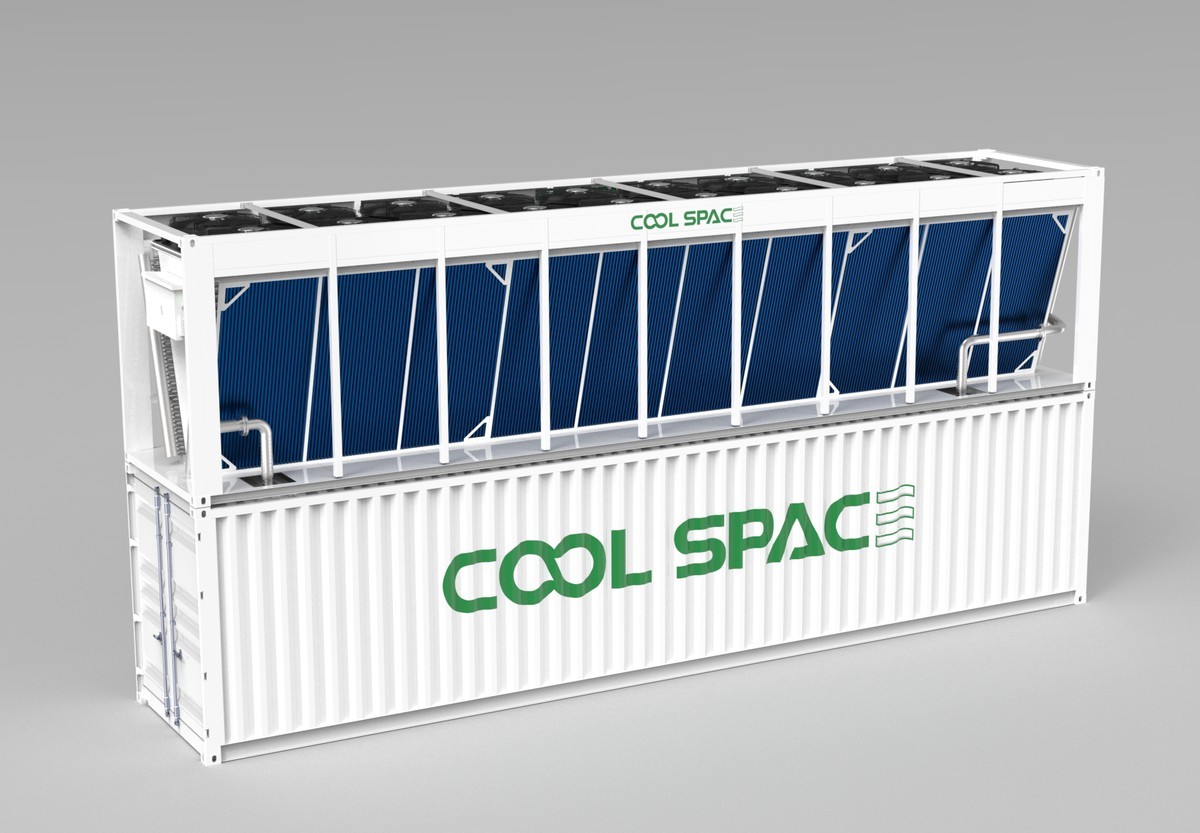
A CoolSpace containerized data center module — fully integrated with IT racks, hydro-cooling, and power distribution in a factory-tested enclosure.
Anatomy of a Modular Data Center Unit
A well-engineered modular data center is not a shipping container with servers inside. It is a purpose-built, thermally optimized enclosure designed to operate as a self-contained computing environment. The key subsystems include:
IT compartment. Server racks pre-installed and cabled, with structured cabling for power and network. Rack densities of 30–60kW per rack are standard in hydro-cooled modular configurations, compared to 8–15kW in conventional raised-floor deployments.
Cooling system. Closed-loop hydro-cooling circuits with redundant pumps, heat exchangers, and dry coolers. The cooling system is factory-calibrated to the specific rack configuration and heat load profile of the module. PUE values below 1.15 are achievable under typical operating conditions.
Power distribution. Integrated busway or PDU systems with metering at the rack level. Modules are designed for connection to external UPS and generator systems at the site level, with clear demarcation points for electrical handoff.
Monitoring and control. Environmental sensors (temperature, humidity, leak detection, airflow) connected to a centralized building management system (BMS) via standard protocols. Remote monitoring capability is built in from the factory.
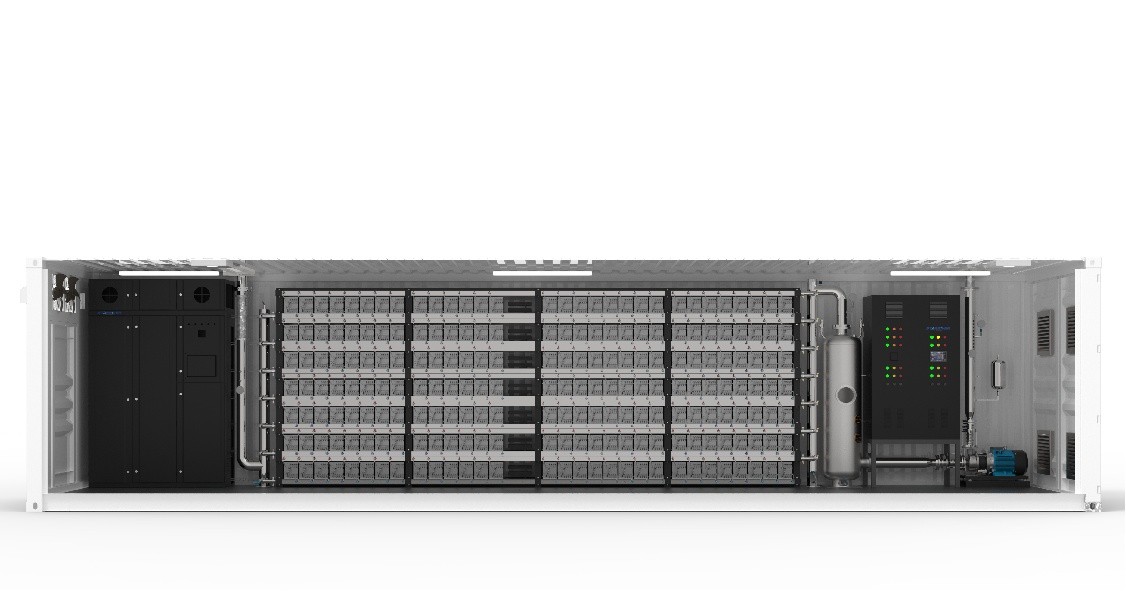
Internal layout of a CoolSpace SR2 A1 containerized module showing the integrated IT compartment, cooling manifolds, and power distribution pathways.
The Density Advantage
One of the most compelling arguments for modular deployment is power density per unit of physical space. A conventional data center with raised-floor air cooling typically operates at 1–2 kW per square meter of total building footprint (including aisles, CRAH units, and support space). A modular hydro-cooled unit can deliver 8–12 kW per square meter of footprint — a 4–6x improvement.
This density advantage translates directly to real estate efficiency. A 10MW AI training cluster that would require approximately 8,000–10,000 square meters in a conventional facility can be deployed in roughly 2,000 square meters of modular units. For operators in land-constrained markets or those seeking to co-locate with existing facilities, this reduction in footprint is a significant strategic advantage.
The density is enabled primarily by the cooling architecture. Hydro-cooling removes the need for large air-handling plenums, raised floors, and wide hot-aisle/cold-aisle corridors. Coolant is piped directly to the point of heat generation — the chip package — through compact manifolds that occupy a fraction of the space required by air-based systems.
Deployment Models: Edge, Campus, and Hybrid
Modular data centers serve three primary deployment models, each with distinct operational requirements:
Edge deployment. Single or small clusters of modules placed at locations close to data sources or end users — telecommunications towers, manufacturing facilities, research campuses, or mining operations. Edge modules are typically self-contained, with integrated cooling and power conditioning, as documented in IEA's global data center infrastructure analysis.
Campus deployment. Multiple modules arranged in a planned layout, sharing common power infrastructure (substations, generators, UPS systems) and network connectivity. This model provides the scalability of a traditional campus with the speed and density advantages of modular construction.
Hybrid deployment. Modular units added to existing conventional data centers to provide high-density capacity for AI workloads without retrofitting the entire facility. The existing building handles storage, networking, and lower-density compute, while the modular units serve the GPU-intensive training and inference workloads.
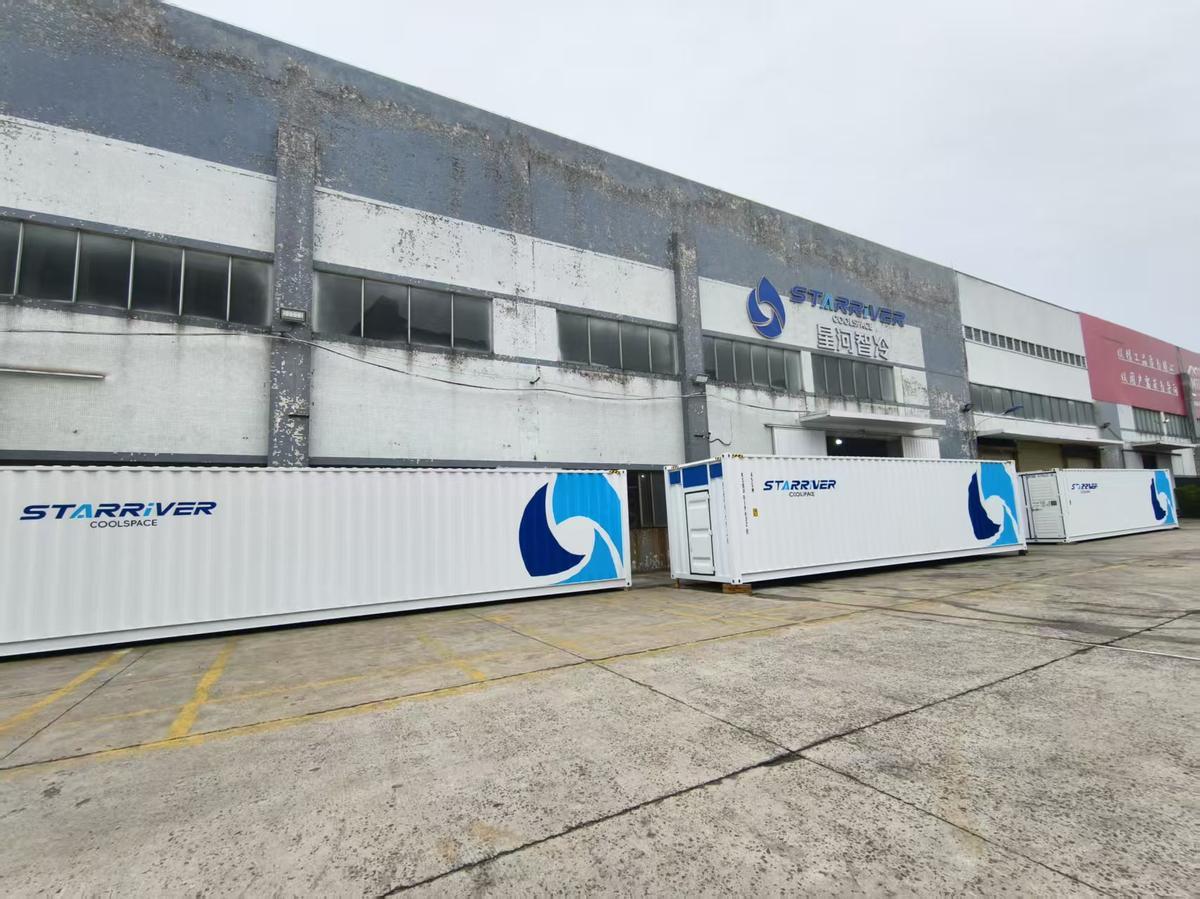
CoolSpace containerized modules undergoing final assembly and quality assurance testing before deployment.
Financial Comparison: Build vs. Deploy
The total cost of ownership comparison between traditional and modular approaches depends on scale, location, and timeline, but several consistent patterns emerge from Open Compute Project member deployments:
- Capital cost per kW of IT capacity: Modular deployments typically cost 15–25% less per kW than equivalent stick-built facilities, primarily due to factory manufacturing efficiencies and reduced on-site labor costs.
- Time to revenue: The 12–16 month construction time saved translates directly to earlier revenue generation. For a 10MW facility generating $200–400/kW/month in colocation revenue, each month of earlier operation represents $2–4 million in additional revenue.
- Incremental scaling: Modular deployment allows operators to add capacity in 500kW–2MW increments, matching supply to demand. Traditional builds require committing to 5–20MW blocks, creating stranded capital during ramp-up periods.
- Residual value: Modular units can be relocated, repurposed, or resold. A fixed building cannot. This flexibility has quantifiable value in markets where demand geography shifts over 5–10 year planning horizons.
Explore Further
CoolSpace specializes in modular hydro-cooled data center infrastructure designed for rapid deployment at any scale. From single-module edge deployments to multi-megawatt campus configurations, every unit is factory-tested and delivered ready for operation.
Explore the CoolBase-1080A/W for AI data center deployments or the SR40 V3 Hydro Cooling Container for high-density compute applications. Contact the engineering team to discuss your deployment timeline and capacity requirements.
Follow CoolSpace for the latest in data center infrastructure: LinkedIn · News & Updates