Liquid Cooling for High-Density Mining Operations
- Share
- publisher
- CoolSpace
- Issue Time
- Oct 14,2026
Summary
Mining profitability is determined as much by cooling infrastructure as by hashrate. Hydro-cooled mining operations achieve 15-30% lower energy costs per terahash while extending ASIC hardware lifespan by reducing thermal stress. This guide examines the engineering and financial case for hydro-cooling in mining at scale.
Bitcoin Mining and Hydro-Cooling: Engineering Profitability Through Thermal Efficiency
Reading time: 7 min read | Published: October 14, 2026 | Category: Industry Insights
In this article: Key Takeaways · The Thermal Economics of Mining · Where Air Cooling Falls Short · The Hydro-Cooling Advantage for Mining · Deployment at Scale · ROI Analysis · Explore Further
Key Takeaways
- Energy represents 60–80% of operational expenditure in Bitcoin mining — cooling system efficiency directly impacts the cost per bitcoin mined, as reported by the Cambridge Centre for Alternative Finance.
- Hydro-cooled ASIC miners can operate at sustained boost frequencies that air-cooled units cannot maintain, yielding 10–20% higher effective hashrate from the same hardware.
- Thermal cycling is the primary cause of ASIC board failure — hydro-cooling reduces temperature variance from ±15°C to ±2°C, significantly extending mean time between failures.
- Containerized hydro-cooled mining units enable rapid deployment to sites with favorable power costs, supporting the operational flexibility that mining economics demand.
The Thermal Economics of Mining
Bitcoin mining is fundamentally a competition of energy efficiency. Every ASIC miner converts electrical energy into two outputs: cryptographic hashes and heat. The ratio between useful computation and waste heat determines profitability at any given bitcoin price and electricity rate.
A modern ASIC miner — such as the Bitmain Antminer S21 series — operates at approximately 3,500W per unit, producing roughly 200 TH/s. At scale, a 10MW mining facility runs approximately 2,800 of these units, generating 10MW of heat that must be removed continuously. The cost and efficiency of removing that heat is not a secondary concern — it is a primary determinant of whether the operation is profitable.
According to data from the Cambridge Bitcoin Electricity Consumption Index, the global Bitcoin network consumes approximately 150 TWh annually. At the facility level, cooling overhead typically adds 20–40% to the direct IT power consumption in air-cooled operations. Reducing this overhead by even 10 percentage points translates to millions of dollars in annual savings at the 10MW+ scale.
Where Air Cooling Falls Short in Mining Operations
Most Bitcoin mining facilities today rely on air cooling — either through purpose-built data halls with industrial fans or through open-air configurations using ambient air. While air cooling has the advantage of simplicity, it introduces several constraints that become increasingly costly at scale:
Climate dependency. Air-cooled mining facilities are operationally constrained by ambient temperature. During summer months or in warm climates, inlet air temperatures rise above 35°C, forcing miners to either throttle hashrate or accept elevated failure rates. This seasonal variability creates unpredictable revenue profiles.
Dust and particulate exposure. Open-air or evaporative cooling systems expose ASIC boards to dust, moisture, and corrosive particulates. Board-level corrosion and fan bearing failures are leading causes of unplanned downtime in air-cooled mining operations.
Noise and site restrictions. Air-cooled mining facilities generate noise levels of 80–95 dBA at the perimeter, limiting site options and creating community opposition in populated areas. Several jurisdictions have enacted noise ordinances specifically targeting mining operations.
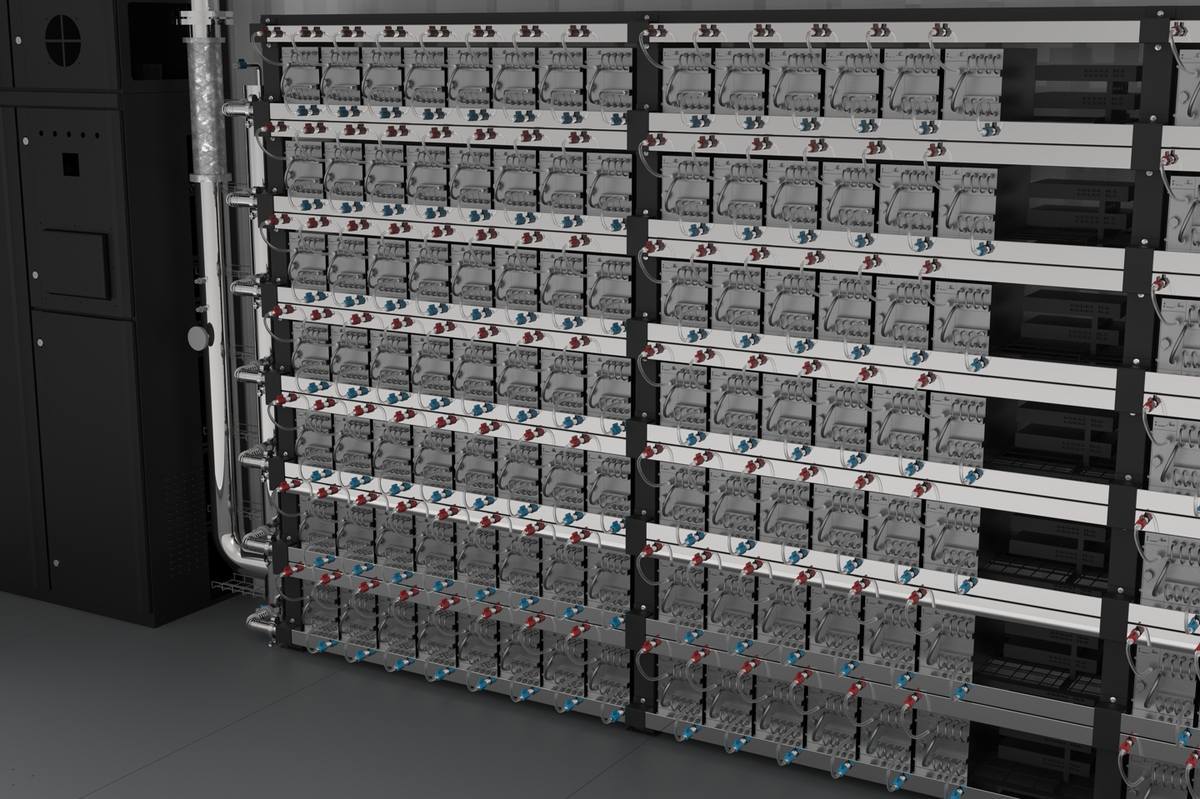
Hydro-cooled mining rack manifold connections — closed-loop coolant delivery eliminates airborne contamination and provides precise temperature control across every ASIC unit.
The Hydro-Cooling Advantage for Mining
Hydro-cooling addresses each of the limitations above while adding performance benefits that air cooling cannot replicate:
Climate independence. Closed-loop hydro-cooling systems maintain consistent coolant supply temperatures regardless of ambient conditions. Whether the facility operates in a desert at 45°C or a Nordic winter at -20°C, the ASIC junction temperatures remain within the optimal operating band. This eliminates seasonal hashrate variance and enables site selection based purely on power cost and availability.
Hardware longevity. The primary failure mechanism in ASIC miners is thermal fatigue — repeated expansion and contraction of solder joints as chip temperatures fluctuate. Hydro-cooling reduces thermal cycling amplitude from ±15°C (typical in air-cooled setups) to ±2°C, as documented in JEDEC semiconductor reliability standards. Field data from hydro-cooled mining operations shows 40–60% reduction in board replacement rates compared to air-cooled equivalents.
Overclocking headroom. ASIC manufacturers specify conservative operating frequencies based on worst-case thermal conditions. With hydro-cooling maintaining junction temperatures 15–25°C below air-cooled levels, operators can safely increase clock frequencies by 10–20%, yielding proportionally higher hashrate from the same hardware investment. This is not theoretical — it is standard practice in well-managed hydro-cooled mining operations.
Noise elimination. Hydro-cooled mining containers operate at noise levels below 65 dBA at one meter — comparable to a normal conversation. This opens site options that would be impossible for air-cooled operations, including urban industrial zones, co-located facilities, and sites near residential areas.
Deployment at Scale: Containerized Mining Infrastructure
The operational demands of mining — rapid deployment to capture favorable power contracts, the ability to relocate when power economics shift, and precise scaling to match available capacity — align naturally with containerized modular infrastructure.
A well-designed containerized mining unit integrates the mining hardware, hydro-cooling system, power distribution, and monitoring into a single transportable enclosure. These units arrive at site pre-loaded with miners, pre-filled with coolant, and pre-commissioned — ready for operation within days of power and network connection.
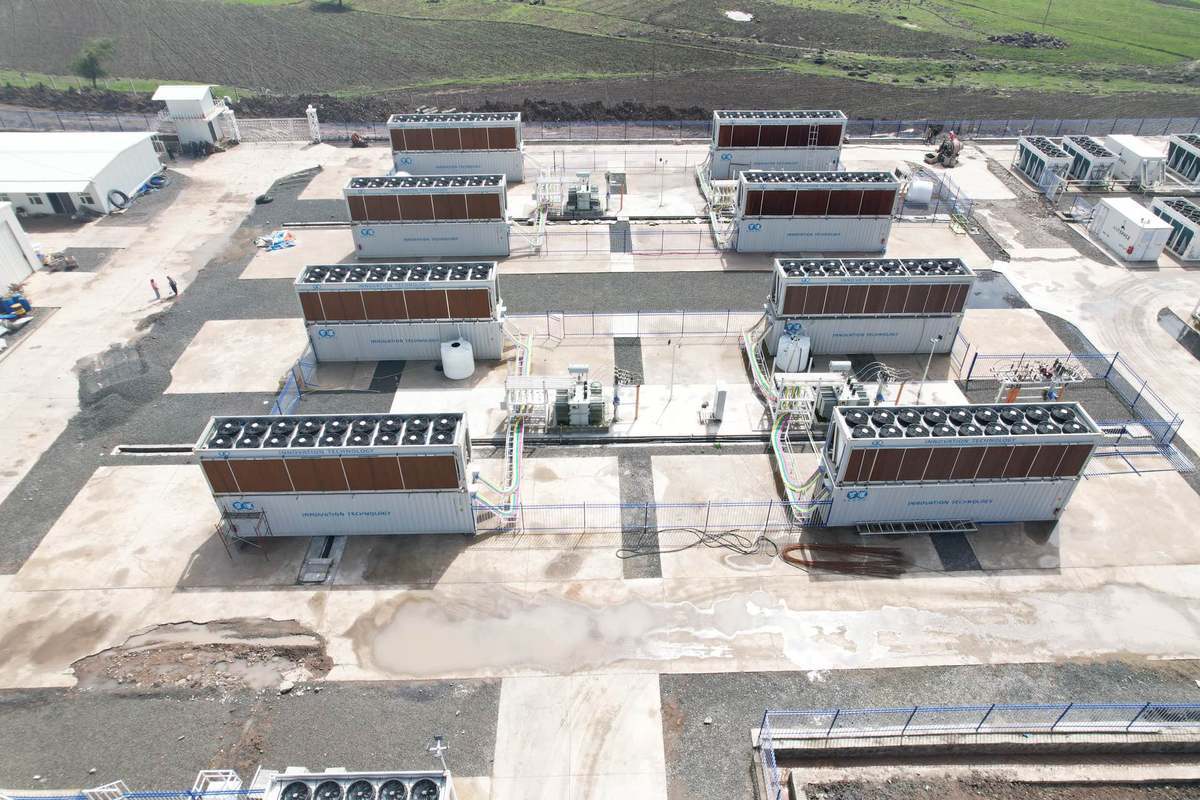
A large-scale containerized mining deployment — modular units enable rapid scaling from 1MW to 50MW+ by adding pre-commissioned containers to the site.
Containerized deployment also supports the geographic flexibility that mining economics demand. When a power purchase agreement expires or a more favorable opportunity emerges in another jurisdiction, containerized units can be transported to the new site. This optionality has real financial value in an industry where power cost differentials of $0.01–0.02/kWh can determine whether an operation is profitable or not.
ROI Analysis: Air-Cooled vs. Hydro-Cooled Mining
For a 10MW mining operation running S21-class ASIC miners, the financial comparison between air and hydro-cooling is instructive:
- Energy savings: Hydro-cooling reduces cooling overhead from ~35% of IT load (air) to ~8% (hydro). On a 10MW IT load at $0.05/kWh, this saves approximately $1.2 million per year in cooling energy alone.
- Hashrate uplift: A conservative 15% overclocking gain on 2,800 miners yields an additional 84,000 TH/s. At current network economics, this represents $800K–1.5M in additional annual revenue.
- Hardware savings: A 50% reduction in board replacement rates on $3,000–5,000 boards translates to $500K–800K in reduced annual maintenance costs.
- Payback period: The premium for hydro-cooling infrastructure over equivalent air-cooled capacity typically pays back within 10–16 months through combined energy savings, hashrate gains, and reduced hardware replacement.
Explore Further
CoolSpace engineers and manufactures containerized hydro-cooling infrastructure specifically designed for cryptocurrency mining operations at any scale. From pilot deployments to 50MW+ mining campuses, every container is factory-tested and delivered ready for rapid commissioning.
Explore the SR40 V3 Hydro Cooling Container for mining deployments or contact the engineering team to discuss your project's power capacity, site conditions, and deployment timeline.
Follow CoolSpace: LinkedIn · News & Updates