Air Cooling vs. Hydro Cooling in High-Density Compute Data Center
- Share
- publisher
- James Hu
- Issue Time
- Apr 10,2026
Summary
This article examines the engineering differences between air cooling and hydro cooling in high-density ASIC deployments — covering heat dissipation capacity, operational stability, energy efficiency, and long-term infrastructure scalability. For operators evaluating cooling architecture for new or expanding high-density compute data centers, understanding these differences has direct implications for uptime, hardware longevity, and cost of operation.
Air Cooling vs. Hydro Cooling in High-Density Compute Data Centers: An Engineering Comparison
This article examines the engineering differences between air cooling and hydro cooling in high-density ASIC deployments — covering heat dissipation capacity, operational stability, energy efficiency, and long-term infrastructure scalability. For operators evaluating cooling architecture for new or expanding high-density compute data centers, understanding these differences has direct implications for uptime, hardware longevity, and cost of operation.
The thermal output of modern ASIC hardware used in high-density compute data centers has increased substantially with each successive generation. Where earlier-generation ASICs operated at power densities that air cooling could manage within standard container or warehouse configurations, current-generation hardware — running at 20–30 joules per terahash and beyond — generates heat loads that push the limits of air-based thermal management at scale.
For operators building or expanding high-density compute data center infrastructure, cooling architecture is no longer a secondary consideration. It is a primary engineering constraint that affects equipment performance, facility design, energy consumption, and ultimately, the economics of the operation.
This article compares air cooling and hydro cooling across the parameters that matter most to high-density compute data center operators: thermal capacity, energy efficiency, operational stability, and deployment flexibility.
---
The Core Challenge: Heat at Density
A modern high-performance ASIC used in high-density compute data centers can draw anywhere from 3kW to over 6kW per unit. A single 40-foot container configured for high-density compute data centers may house hundreds of units, producing aggregate heat loads in the range of 1–2.4MW per container. Managing that volume of thermal output consistently, across continuous 24/7 operation, in environments that may reach ambient temperatures of 40–55°C, is a substantive engineering problem.
The challenge is not simply removing heat — it is removing heat efficiently enough that the energy cost of cooling does not meaningfully erode operational margins, and reliably enough that hardware temperatures remain within operating tolerances under full load at all times.
Air cooling addresses this through high-volume airflow: industrial fans draw ambient air across heat sinks and through the facility, exhausting hot air and replacing it with cooler intake air. Hydro cooling — specifically closed-loop liquid cooling — transfers heat directly from the hardware into a circulating coolant, which carries thermal energy away from the compute units and dissipates it through a dry cooler or heat exchanger external to the high-density compute data center enclosure.
---
How Air Cooling Works — and Where It Reaches Its Limits
Air cooling is well understood, widely deployed, and relatively straightforward to implement. For lower-density configurations and moderate ambient temperatures, it remains a functional approach for high-density compute data centers.
Its limitations become apparent under three conditions:
High ambient temperatures. When intake air is already warm — as is common in tropical, desert, or equatorial environments — the temperature differential available for heat exchange is reduced. Air cooling efficiency degrades, and hardware temperatures rise toward the upper end of operational tolerances. Operators may be forced to derate hardware or reduce clock speeds to maintain thermal headroom, directly reducing compute output.
High power density. As ASICs are packed more densely to maximize the compute capacity of a given footprint, airflow dynamics become increasingly difficult to manage. Hot and cold aisle configurations, blanking panels, and precision airflow management can only compensate so far. Beyond a certain density threshold, adequate airflow volume cannot be maintained without infrastructure and energy costs that offset the density gains.
Continuous full-load operation. Air cooling systems are typically sized for average or design-day conditions. During extended periods of peak thermal output — or in facilities where operational load is consistently at or near maximum — the margin between operating temperature and thermal limits narrows. This creates risk of hardware degradation over time and reduces tolerance for ambient temperature variation.
---
How Hydro Cooling Works — and What It Changes
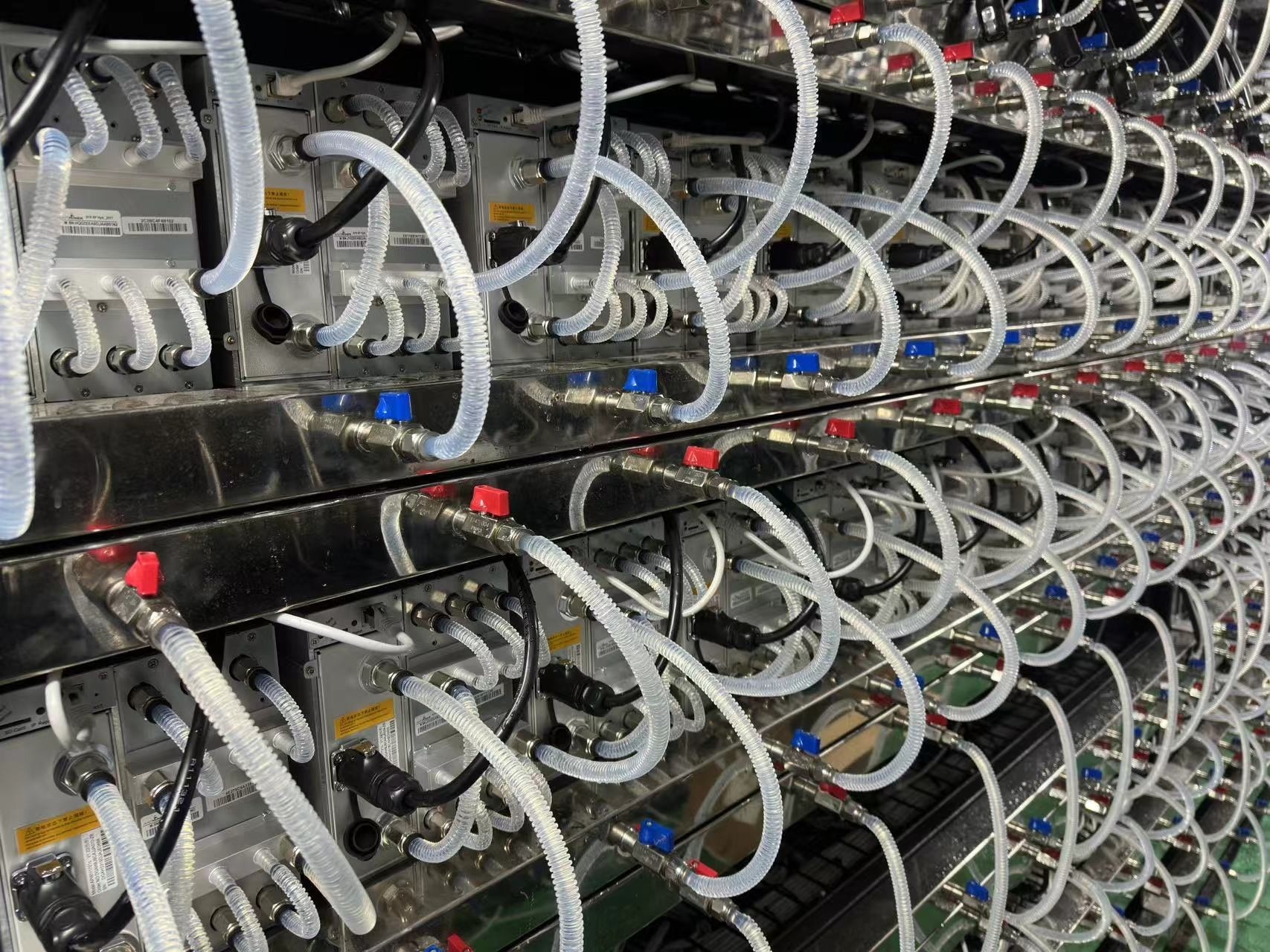
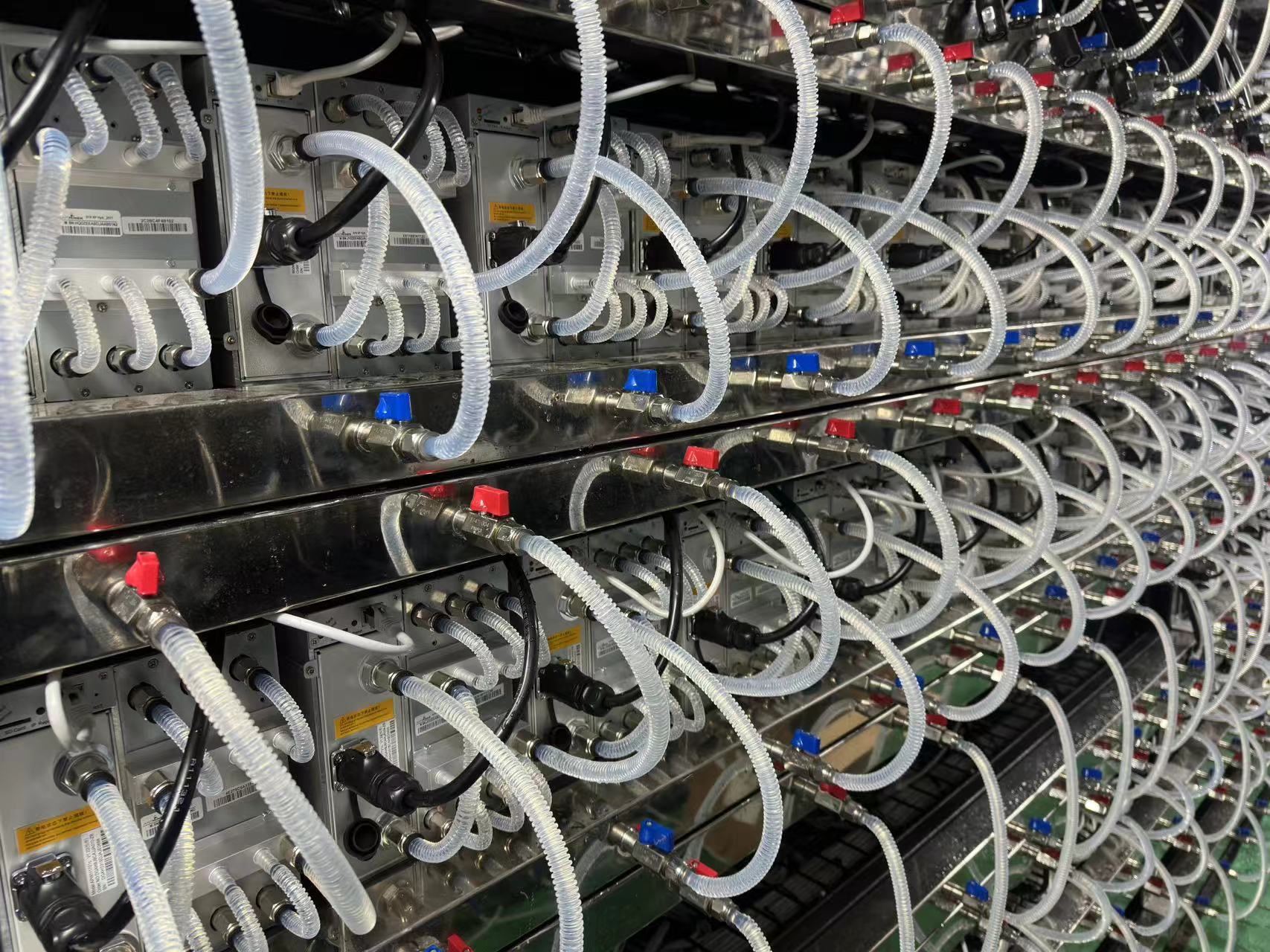
Closed-loop hydro cooling replaces air as the heat transfer medium with a liquid coolant — typically water or a water-glycol mixture — circulated through a manifold system that interfaces directly with the high-density compute data center hardware. Heat transfers from the ASIC chips and power components into the coolant, which is pumped to an external dry cooler or heat exchanger where the thermal energy is dissipated to the atmosphere before the cooled liquid returns to the circuit.
Because liquids have significantly higher thermal conductivity and heat capacity than air, the same volume of coolant can carry substantially more heat than an equivalent volume of air. This translates into several engineering advantages:
Higher sustainable power density. Hydro cooling can support power densities per enclosure that are not practically achievable with air, enabling operators to concentrate more compute capacity into a given physical footprint without degrading thermal management.
Performance stability across ambient conditions. A closed-loop system's thermal performance is largely decoupled from ambient air temperature. The dry cooler or heat exchanger is designed to dissipate a defined heat load, and system performance degrades far less dramatically in high-ambient-temperature environments than air cooling does. This is particularly relevant for high-density compute data center operations in equatorial Africa, the Middle East, or Southeast Asia.
Reduced cooling energy consumption. Moving coolant through a closed loop requires significantly less fan energy than moving the equivalent volume of air required for comparable heat removal. This directly improves the Power Usage Effectiveness (PUE) of the facility — the ratio of total facility energy consumption to IT load energy consumption. Well-designed hydro cooling systems can achieve PUE values below 1.1, compared to 1.3–1.5 or higher for air-cooled facilities.
Acoustic profile. Hydro-cooled enclosures operate at substantially lower noise levels than high-volume air cooling configurations, which can be a practical consideration for certain site types and regulatory environments.
---
Real-World Deployment Considerations
Hydro cooling introduces infrastructure requirements that air cooling does not. Operators evaluating a transition should account for:
Coolant circuit integrity. A closed-loop system requires properly designed and maintained connections, appropriate coolant chemistry, and monitoring for pressure and flow rate. Leak detection and containment design are standard engineering considerations for any liquid cooling installation in high-density compute data centers.
Dry cooler or heat exchanger siting. External heat rejection equipment must be sited with adequate airflow clearance and located to manage the piping distances to the high-density compute data center enclosure. In containerized deployments, dry coolers are typically roof-mounted or positioned adjacent to the container, and the system is designed as an integrated unit.
**Water quality and chemistry. **Coolant systems require periodic maintenance to manage mineral buildup, biological growth, and corrosion inhibitor levels. In regions with variable water quality, proper treatment protocols are part of the operational program for high-density compute data centers.
**Integration with existing infrastructure. **For operators retrofitting an existing site, hydro cooling integration requires assessment of power distribution, structural considerations for equipment weight, and interface design with existing monitoring and control systems.
For new-build containerized deployments, many of these considerations are resolved at the design stage. Purpose-built hydro-cooling containers integrate the cooling circuit, dry cooler, power distribution, and monitoring infrastructure as a single engineered unit, reducing site integration complexity for high-density compute data centers.
---
## Why It Matters for Operators
The business case for hydro cooling in high-density compute data center infrastructure comes down to three factors: uptime, efficiency, and scalability.
**Uptime. **Hardware operating within its designed thermal envelope degrades more slowly and experiences fewer thermal-related failures. For operations running at continuous full load, the difference between stable thermal management and marginal air cooling can meaningfully affect hardware replacement cycles and maintenance costs over a multi-year deployment.
**Efficiency.** A reduction in PUE from 1.4 to 1.08 on a 2MW high-density compute data center load represents roughly 640kW of cooling overhead eliminated. At typical industrial electricity rates, that difference has a direct impact on operating cost per unit of compute — and therefore on profitability.
**Scalability. **Containerized hydro cooling systems support modular capacity expansion. Adding compute capacity means deploying additional container units rather than redesigning facility-wide airflow infrastructure. This makes capacity planning more predictable and capital allocation more efficient.
---
Conclusion
Air cooling has been the default for high-density compute data center infrastructure for many years, and it remains workable for lower-density configurations in temperate environments. But as ASIC hardware continues to advance and operators seek to maximize returns from available power capacity, the thermal management requirements of high-density compute data centers are increasingly difficult to meet with air alone.
Hydro cooling — particularly in containerized, purpose-built configurations — offers a technically sound approach to these constraints: higher sustainable density, improved energy efficiency, greater performance stability across environments, and a modular deployment model suited to the scaling patterns of high-density compute data center operations.
For operators designing infrastructure intended to run at full capacity, in variable environments, over multi-year horizons, the engineering case for liquid cooling is straightforward.
CoolSpace designs and manufactures hydro-cooling container systems built for exactly these conditions. To discuss specific deployment requirements for high-density compute data centers, contact the engineering team or review system specifications on our Products page.